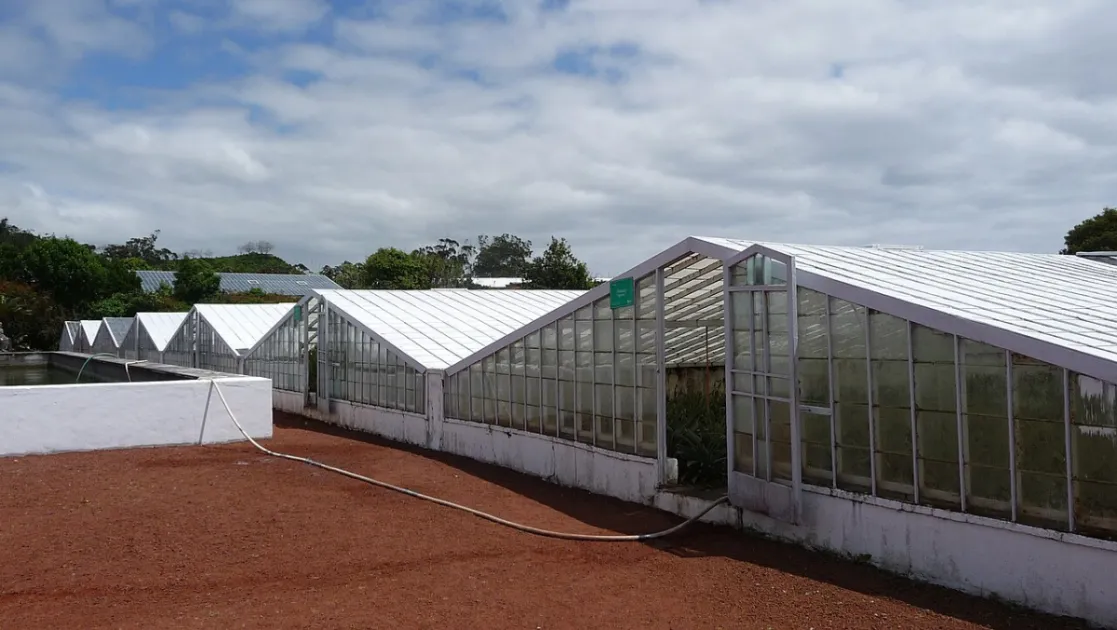
On São Miguel, pineapples grow under glass. Instead of open fields you see rows of timber-and-glass greenhouses with whitewashed panes, and inside them a fruit that takes about two years to ripen. It is one of the island's best-known products and an easy stop to fit into a day around Ponta Delgada.
This guide explains how the Azores pineapple is produced, where the tradition comes from, which plantations you can visit and what to taste. The facts come from the plantations' own websites and from a travel guide quoted throughout. Opening times, prices and visiting conditions change, so always check before you go.
Overview
The Ananás dos Açores is a fruit with Protected Designation of Origin (PDO), produced exclusively on the island of São Miguel. The brand's website speaks of more than 150 years of history. It is not an open-field crop: the plant grows in greenhouses, in an environment meant to recreate the warmth of the climates it comes from.
If you are still shaping your trip, start with the São Miguel island page and the guide to São Miguel by area, to see where a plantation visit fits into your route.
History of Pineapple on São Miguel
According to Azores Getaways, the pineapple reached the Azores in the mid-19th century as an ornamental plant. When the orange trade, which São Miguel exported in large quantities, declined, a new export product was needed. The first greenhouses appeared, with pineapples grown in pots, and enthusiasm led to many more being built in and around Ponta Delgada, in places such as Vila Franca do Campo, Ribeira das Tainhas, Ponta Garça, Lagoa and Ribeira Grande.
The same source mentions greenhouses for 40,000 pineapples in 1875 and exports to England, Germany and Russia in 1913. The two world wars disrupted trade, and today exports are minimal: the fruit is mostly eaten on the island and sold to visitors. As for Augusto Arruda, the website of the plantation that bears his name says he committed to this crop in 1919, on a former orange farm in Fajã de Baixo.
How It Is Grown in Greenhouses
The Ananás dos Açores website describes the full cycle, which lasts about two years (Azores Getaways gives 18 to 24 months). These are the main stages.
- Planting the stumps: the rhizome of plants that fruited well the previous year is removed and planted (4 to 6 months).
- Suckers: the small plants growing from the mother stump are moved to another greenhouse with more room (6 to 8 months).
- Final planting: the plants go into the traditional timber-and-glass greenhouse, where they stay until harvest.
- Whitewashing: lime milk applied to the glass protects the leaves from sunburn, especially in spring and summer.
- Watering: the greenhouses collect rainwater in tanks; watering is weekly in summer and every two weeks in winter.
- Smoke: about 5 to 7 months after final planting, organic material is burned in cans inside the greenhouse. The smoke contains ethylene, which induces flowering and gives a more even harvest.
- Crown capping: when the fruit is about a third of its final size, the central meristem is removed, which is why the crown is smaller.
- Harvest: about two years after the stump is planted, once the fruitlets show at least 25% orange colouring. The rhizome is taken from the fruit and grows new plants.
According to Azores Getaways, during the smoke treatment the greenhouses stay closed for about a week and the temperature inside can reach 40 ºC. What you see on a visit therefore depends on the stage each greenhouse is in.
Where to Visit the Plantations
Not every plantation is open to the public. Azores Getaways names four that receive visitors, and what we know about each comes from the websites linked below.
Augusto Arruda Pineapple Plantation (Fajã de Baixo)
Azores Getaways describes it as the oldest on the island and one of the most visited. On its own website the plantation presents itself as a living museum more than 100 years old, and says visits are free and show every stage of the pineapple's growth. In the shop you can taste the A. Arruda pineapple liqueur, made to a family recipe, and there is local craftwork. The kiosk serves juice, cake, piña colada, pineapple mojito and the fruit itself. Details and contacts are on the official website.
Other plantations open to visitors
The same guide mentions the Plantação de Ananás dos Açores, the Herdade do Ananás and Ananás de Santo António, with guided greenhouse visits and tastings. The first has its own page at ananasdosacores.pt, which points to a visits page. We have not confirmed opening times, prices or booking rules for these three, so check their official pages before you go. If you are staying in Ponta Delgada, our guide to what to see in Ponta Delgada helps you combine the visit with the rest of the day.
Products to Taste and Take Home
To be sold, a pineapple must meet demanding criteria: cylindrical shape, strong orange skin, translucent yellow flesh, a sweet-and-sour taste and a pleasant aroma. According to Azores Getaways, fruit that falls short is not wasted and becomes liqueurs, mustard, jams, juices and cocktails.
In practice, this means pineapple turns up in many forms. At the Arruda plantation there is liqueur, cake, juice and cocktails, and the Ananás dos Açores brand has an online shop (it asks you to confirm you are of age because it sells alcoholic drinks). For more local flavours, see our guides to food markets and local products and Azorean cuisine.
Planning Your Visit
- Check opening hours, days and visiting conditions on each plantation's website.
- Ask whether the visit is guided and whether a tasting is included.
- The cycle lasts about two years, so what you see depends on the greenhouse, not the season.
- If you plan to buy products, see what each shop sells and leave room in your luggage.
Pair the visit with another local-production stop, such as the tea plantations of Gorreana and Porto Formoso, for a day devoted to what the island produces.
FAQ
Is Azores pineapple grown on every island?
No. The Ananás dos Açores, a Protected Designation of Origin fruit, is produced exclusively on the island of São Miguel.
How long does a pineapple take to grow?
About two years from planting the stump, according to the Ananás dos Açores website. Azores Getaways gives 18 to 24 months.
Can I visit the plantations?
Yes, some are open to the public. The Arruda plantation's website says visits are free; for the others, check the conditions on their official websites.
Why are the greenhouse windows white?
They are coated with lime milk (whitewashing), which protects the pineapple leaves from sunburn caused by direct sunlight, especially in spring and summer.
Final Thoughts
The São Miguel pineapple is a good way to understand how the island has reinvented itself over the centuries: from ornamental plant to export product, and today a tradition you can visit and taste. An hour or two at a plantation is enough to see the greenhouses, understand the method and try the fruit or a liqueur.
Before you go, confirm times and prices on the official websites, because they can change. Then leave some room in your bag for a pineapple-flavoured souvenir.