Ponta Delgada is where almost every visit to São Miguel begins, and many people pass through it on the way to somewhere else: the airport, the harbour, the road to the lakes. It deserves a full morning. The historic centre is compact and easy to walk, and it has two landmarks that explain the city better than any leaflet: the Portas da Cidade and the Igreja Matriz de São Sebastião.
This guide gathers what can be confirmed from public sources, such as the city's tourism pages and heritage listings, and it is frank about what we could not confirm, such as opening hours and entry rules. Where that happens, we tell you who to ask.
Overview: a city made for walking
The part that matters to visitors sits close to the seafront, around the Largo da Matriz and the Praça Gonçalo Velho Cabral. You will find traditional shops, benches to rest on, cafés and souvenir stores selling Azorean keepsakes. If you arrive in the morning after a night flight or a boat trip, this is an easy first contact with the island.
If you are short on time, the classic combination is to walk through the Portas da Cidade, step into the Largo da Matriz and make a short detour to the Campo de São Francisco. If you have longer, the city works as a base for day trips. Further down we explain how to fit it all together.
Portas da Cidade: the postcard of Ponta Delgada
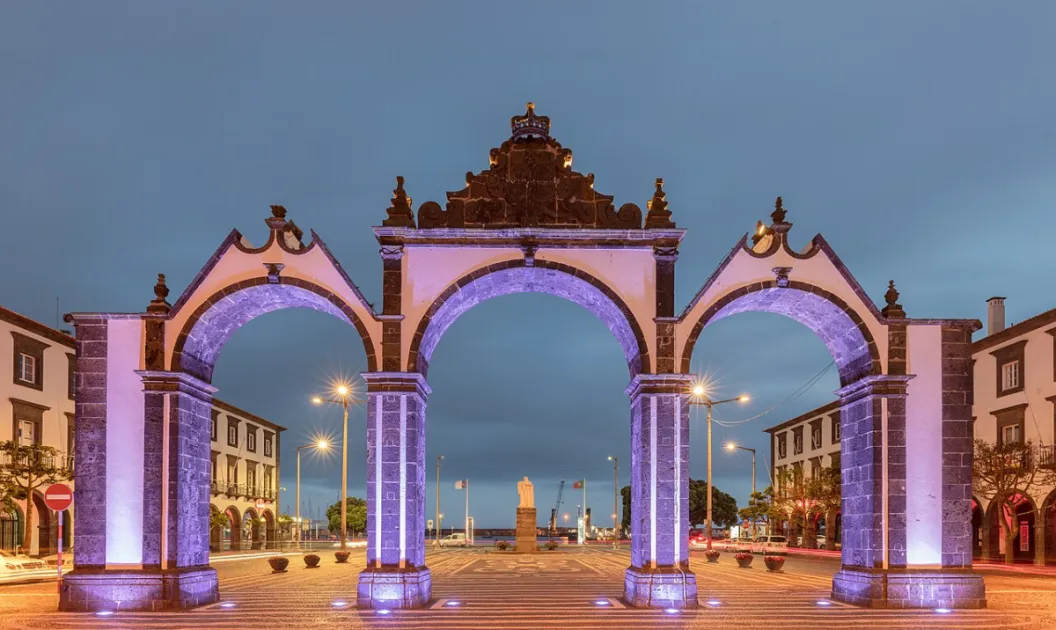
The Portas da Cidade, or City Gates, are the most photographed monument in Ponta Delgada and are often described as the city's calling card. They have three arches, with the royal coat of arms and the city's arms in the middle. They stand in the heart of town, in the parish of São Sebastião, and make the most natural starting point for any walk.
The monument has moved house. In 1783 the gates stood by the old quay, which no longer exists. In 1952, after works on Avenida Infante Dom Henrique, also known as the Avenida Marginal, they were transferred to the Praça Gonçalo Velho Cabral, where they remain. They have been classified as a Property of Public Interest since 1953.
The square is also an urban stage. It serves as the backdrop for events such as the presentation of the Azores Airlines Rallye, the Festas do Divino Espírito Santo and the Christmas and New Year celebrations. If your trip coincides with one of these, check the programme on the municipality's official channels. Through the arches you can see the Largo da Matriz, which makes this one of the easiest photographs in the city.
Igreja Matriz de São Sebastião
Ponta Delgada's mother church, the parish church of São Sebastião, stands on the Largo da Matriz. According to the municipal tourism heritage entry, work on the present church began in 1531, after a vow made in time of plague to build a new temple to Saint Sebastian and make him the city's patron, with the backing of King João III. The church opened for worship in 1550 and the facade was retouched in 1575.
The bell tower was completed in 1623 by the Câmara Municipal after being left unfinished. A campaign in 1748 modernised the facade while keeping the old portals. In 1895 the commander António Joaquim Nunes da Silva bequeathed a clock with four illuminated faces. During the Second World War the tower was camouflaged to protect it from possible air raids. The entry itself calls the church always unfinished, which helps explain the mix of periods.
The plan is polygonal, with three naves, two deep side chapels on each side and a three-part chancel. The facades are rendered and painted white, except for the main chancel and the second level of the tower, which are bare stone. That contrast between white and dark stone is what many visitors notice first. The church has been a Property of Public Interest since Decree 39 175 of 17 April 1953.
Visiting hours and entry conditions are not given in the entry we consulted, so we do not state them. Check with the parish or on the city tourism portal before counting on a visit. This is a working church, so enter quietly, avoid services and ask before photographing the interior.
A city with centuries of history
It helps to know where the city comes from. The settlement received its charter from King Manuel on 29 May 1507, in Abrantes, and became a town. It was raised to city status by a decree of 2 April 1546, in the reign of João III. So when the Matriz opened for worship in 1550, Ponta Delgada had only just become a city.
Another well-known episode is the naval Battle of Ponta Delgada, fought off the coast on 26 July 1582. For the wider context, our article on the history of the Azores gives the background of the archipelago.
Beyond the square: convent, fort and gardens
On the Campo de São Francisco stands the Convent of Nossa Senhora da Esperança, home to the image of the Senhor Santo Cristo dos Milagres, linked to the yearly Easter celebrations. Dates and programmes change from year to year, so check the official calendar before planning a trip around them.
Opposite the Campo de São Francisco, along the coastal road, is the Forte de São Brás. The city also has 19th-century gardens created during its greening period, such as the Jardim António Borges. We found no confirmed hours or access rules for these places, so please check on Visit Ponta Delgada or Visit Azores.
A suggested walking route
We give no times or distances, because we did not measure them. The order below follows the logic of the map and can be done slowly or quickly.
- Start at the Portas da Cidade in the Praça Gonçalo Velho Cabral and look at the coat of arms in the middle of the three arches.
- Walk through the arches to the Largo da Matriz and take in the white facade and the clock tower.
- If the church is open and no service is under way, step inside quietly.
- Wander the smaller streets around it, where you will find traditional shops, cafés and souvenir stores.
- Follow the seafront road to the Campo de São Francisco and the Forte de São Brás.
Practical information: what to check before you go
The most useful practical information is what we cannot guarantee: opening hours of churches, museums and gardens, and any entrance fees. These details change, so always confirm them at the source, the Visit Ponta Delgada portal. The entry for the Matriz church is there too.
Weather in the Azores changes quickly. If you travel outside summer, our article on the Azores in winter helps you plan the days, and the plan for one week in São Miguel shows how to swap activities when it rains.
To choose where to sleep, see the guide to São Miguel by area. For more heritage, open the list of monuments and the page for the island of São Miguel.
After the centre: day trips and cruise stops
Ponta Delgada is the natural base for leaving town. Our article on day trips from Ponta Delgada compares the most common excursions on the island, and if you arrive by ship, the guide to the cruise stop in Ponta Delgada organises the day around your ship's departure time.
If you have only a few hours, you can do just the walk in this article and return on board unhurried. If you stay several days, you have time to see the centre in the late afternoon, when the light is good for photographing the facade of the Matriz.
FAQ
Where are the Portas da Cidade?
In the Praça Gonçalo Velho Cabral, in the centre of Ponta Delgada, in the parish of São Sebastião. They have stood there since 1952, after previously being by the old quay.
When was the Igreja Matriz de São Sebastião built?
Work on the present church began in 1531. It opened for worship in 1550 and the bell tower was completed in 1623, so construction runs from the 16th to the 18th century.
Is entry to the Matriz church free?
We could not find that confirmed. Check hours and visiting conditions with the parish or on the city tourism portal.
When did Ponta Delgada become a city?
By a decree of 2 April 1546, in the reign of João III. It had already been made a town in 1507.
Can I see the centre during a cruise stop?
Yes, the walk described here stays within the historic centre. Always confirm your ship's return time and plan around it.
Final thoughts
Ponta Delgada does not impress by scale but by detail: three arches with a coat of arms, a tower that took centuries to finish, a clock with four faces. Give it a morning and you will see why the island starts here.
Before you go, confirm hours, entry rules and events on the official channels, because that is where the information is kept up to date. If something has changed, tell us so we can correct it.