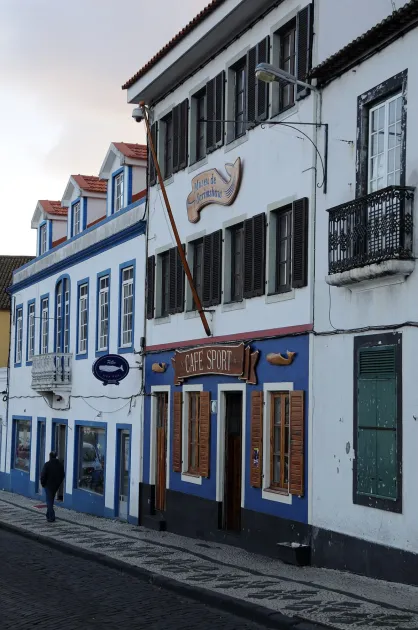
Most sailors who reach Horta by sea head first for a bright blue facade with orange lettering on Rua José Azevedo "Peter". Peter Café Sport is a café, a bar, a meeting point and a piece of North Atlantic sailing history all at once.
This article brings together what the café says about itself in the history section of its official website and the tradition of sailors leaving their mark at Horta marina, on the island of Faial. Where something cannot be confirmed, we say what to check and where.
Why Peter Café Sport is more than a café
The Peter Café Sport website presents itself as an emblematic café with more than a hundred years of history. Among the descriptions it quotes, the most repeated is that of an institution: a place to change money, a yacht club, a post office, an information desk and, in the site's own words, an international drawing room.
For anyone crossing the Atlantic, Horta is a natural stop, and Peter is where that stop gets a face. If you are planning the island, our complete guide to Faial helps place the town, and the 3-day Faial itinerary shows how to fit the café into a three-day trip.
From the Azorean House to Café Sport
The story the café tells starts with Ernesto Lourenço S. Azevedo (1859-1931), who ran a craft bazaar on Largo do Infante selling embroidery, lace, hats and straw baskets. In 1888 he took those products to the Lisbon Industrial Exhibition and won a gold medal and diploma.
Around the turn of the century he moved to Rua Tenente Valadim, into one of the buildings that are now part of Peter, and called the business the "Azorean House". He began selling drinks as well, and he was closer to the port, then the only way in and out for people and goods on the island.
In 1918 his son Henrique Azevedo moved the business to the neighbouring building and renamed it "Café Sport", in honour of his passion for football, rowing and billiards. According to the site, he introduced traits that still define Peter: the furniture, the eagle as a symbol and the gin and tonic as a much-loved drink.
How José Azevedo became Peter
In the late 1930s José Azevedo, Henrique's son, started helping at the café while also working on the British ship HMS Lusitania II of the Royal Navy, anchored in Horta since 1939. He built strong ties with the crew, and an officer asked whether he minded being called "Peter". The name stuck, and for the rest of his life José Azevedo was Peter.
In 1944, with a huge flow of ships arriving in Horta during the war, he began working full time at the café, which became a reference point for shipwreck survivors, the injured and anyone needing shelter or repairs for their boat. Accounts of how the name came about differ slightly in detail, so if that interests you, ask at the café itself.
The adventurers and the yacht flags
According to the site, from 1921 Dutch tugboats were stationed in Horta during winter, and their crews were regular customers of Café Sport. In the late 1950s, and above all in the 1960s, a new kind of visitor arrived: crews of leisure boats, whom the people of Faial called "adventurers" because they braved the ocean in sometimes tiny sailboats.
That is where the habit of leaving a keepsake began. The tradition, also mentioned in an article by SAPO about the café, is to leave the boat's flag as a sign of good luck for the rest of the crossing. Flags from yachts and clubs still hang on the walls today, a custom that began, according to the official history, in the 1975 premises.
The painting tradition of Horta
The Peter website explains that, to meet growing demand, the new Horta Marina was built from 1986. Before that, sailors recorded their passage with a painting on the "paredão da doca", the dock wall, and the custom continued with the marina.
This is the painting tradition of Horta: each crew leaves its passage painted. The site does not describe the paintings in more detail, so we cannot give numbers, exact places or rules. To see them, simply walk around the marina; to learn how the custom works, ask at the marina office or at the café.
The Scrimshaw Museum
Upstairs is the Peter Museum, opened in 1986 and devoted to scrimshaw, the art of engraving and carving sperm whale teeth and bones. The site says the practice began aboard New England whalers and was perfected in the seas of the Azores, and that the museum preserves the memory of whaling, mainly on Faial and Pico.
SAPO describes it as one of the largest scrimshaw museums in the world and mentions works by Azorean artists. If whaling and the sea interest you, round off the visit with our guide to whale watching in the Azores.
How to visit Peter and the marina
The café is at Rua José Azevedo "Peter", no. 9, 9900-027 Horta. The website lists opening hours as Monday to Saturday 09:00 to 24:00 and Sunday 10:00 to 24:00. Hours change, so check the official website before you go, along with museum access and any reservations.
The site also states it is for visitors aged 18 or over because it features alcoholic drinks, and that Peter offers whale watching and other experiences, plus its own gin and an online shop. We give no prices or operators: consult the official pages.
To round off a day at the marina, see the ideas in the Azores sailing and boat tours guide, and for the rest of the island visit the page for the island of Faial.
FAQ
Why is it called Peter?
According to the café's website, José Azevedo was given the name Peter by a British officer of HMS Lusitania II, anchored in Horta during the war, and the name stayed for life.
What are the opening hours of Peter Café Sport?
The site lists Monday to Saturday 09:00 to 24:00 and Sunday 10:00 to 24:00. Always check the official website before you go.
What is the flag tradition?
Yacht crews leave the boat's flag at the café as a sign of good luck for the rest of the voyage, and the flags are displayed on the walls.
Is there a museum at Peter?
Yes, the Scrimshaw Museum, opened in 1986 on the upper floor, devoted to the art of engraving sperm whale teeth and bones. Check access on the official website.
Final thoughts
Peter Café Sport shows how a family business followed the life of a port: from craft bazaar to a support point for people crossing the Atlantic. The marina, the flags and the paintings carry that story on today.
Go with curiosity, have a coffee or a gin and tonic, look at the walls and stroll along the marina. That is how Horta makes the most sense.