The Azores are one of Europe's most botanically remarkable destinations. With more than 80 vascular plant species found nowhere else on Earth, this remote Atlantic archipelago functions as a living laboratory of isolated plant evolution. From the iconic hydrangea-lined roads of São Miguel and Flores to ancient laurel forests that have survived since the Tertiary period, Macaronesian heath blanketing volcanic slopes, and the rare Azores juniper clinging on in its last native refuges, the flora of the Azores rewards every curious traveller and naturalist. This guide covers the four most emblematic species and plant communities of the archipelago, with scientific context, visitor tips, and conservation insights.
Hydrangeas in the Azores: The Flower That Defines the Islands
The hydrangea (Hydrangea macrophylla) is the most visually defining plant of the Azores — yet it is not, in fact, native. Introduced from Japan and China during the 19th century, it found such ideal conditions in the volcanic, acidic soils of the archipelago that it became thoroughly naturalised, lining rural roads and field boundaries across all nine islands. Today it is impossible to picture São Miguel, Faial, or Flores without the brilliant blues, lilacs, whites, and pinks that edge every road from May to September.
The colour of the blooms is determined by soil pH and aluminium availability. Acidic volcanic soils — which dominate the Azores — produce vivid blue and violet tones. As soil alkalinity increases, flowers shift toward pink and red. Because the Azores have naturally acidic substrates, blue is by far the dominant colour across the archipelago, creating the distinctive cobalt-and-green palette that photographers chase every summer. Peak flowering is June–July on most islands, extending into August on higher ground.
Best Islands and Spots to See Hydrangeas
- São Miguel — inland roads: The roads connecting Furnas, Nordeste, and Ribeira Grande are bordered by hydrangeas for kilometres. Drive or cycle the interior between June and August for maximum impact.
- Faial — the "Blue Island": Faial earned its popular nickname "Ilha Azul" specifically because of its hydrangea coverage. The route to the Caldeirão caldera passes through spectacular displays all summer.
- Flores — the whole island: The island's very name (Portuguese for "flowers") reflects its botanical identity. Hydrangeas mix with waterfalls and lakes across the whole landscape in a display considered among the most beautiful in the archipelago.
- Terceira — interior roads: Roads running inland from Angra do Heroísmo toward the geothermal fields pass through notable hydrangea corridors.
Laurel Forest (Laurissilva): A 20-Million-Year-Old Ecosystem
Laurissilva — the laurel forest — is one of the oldest forest ecosystems on the planet. These evergreen broad-leaved forests, dominated by lauraceous tree species, blanketed southern Europe and northern Africa approximately 20 million years ago during the Tertiary period. As the Mediterranean climate shifted to drier, cooler conditions, this ancient forest retreated and eventually disappeared from the European continent. Its last refuge exists in the Macaronesian archipelagos — the Azores, Madeira, the Canary Islands, and Cape Verde — where the warm, humid Atlantic climate preserved the conditions these forests require.
The Madeiran laurisilva was inscribed as a UNESCO World Heritage Site in 1999, recognised as an outstanding example of a globally rare ecosystem. In the Azores, the entire archipelago became a UNESCO Biosphere Reserve in 2022, covering all its protected terrestrial and marine spaces. Before Portuguese colonisation in the 15th century, laurissilva likely covered the majority of the islands. Today, less than 2% of the original native forest cover remains — mostly on the steepest slopes that historically escaped agricultural conversion.
Key Species of the Azorean Laurel Forest
- Azorean Laurel (Laurus azorica): The foundational tree of the native forests, this close relative of the Mediterranean bay laurel is endemic to the Azores. Its berries are a critical food source for endemic birds, most notably the vulnerable Azores bullfinch (Pyrrhula murina, known locally as priolo).
- Azorean Holly (Ilex azorica): Endemic to the archipelago, with narrower leaves than the common European holly. Found in mid-storey layers, especially in the most humid forest patches.
- Pau-branco (Picconia azorica): A slow-growing endemic tree classified as endangered on the IUCN Red List. Produces fruits of high value to native wildlife.
- Faya (Morella faya): A highly abundant sub-canopy tree with black clustered fruits. Fast-growing and robust, it functions as a pioneer species in native forest regeneration.
- Mountain grape (Vaccinium cylindraceum): An endemic blueberry-like shrub distributed across most islands, fruiting abundantly in moist sub-canopy environments.
Altitudinal Zones of Native Forest
The native forest of the Azores is structured in three distinct altitudinal zones:
- Low-altitude forest (0–400 m): Dominated by Morella faya and Picconia azorica. Richest soils; most impacted by historical land use.
- Mid-altitude forest (400–800 m): Core laurissilva zone; dominated by Azorean laurel and holly; habitat of the Azores bullfinch on São Miguel; rich in endemic ferns and rare orchids.
- Cloud forest (800–1,000 m): Permanently bathed in cloud; blanketed in mosses, epiphytes, and giant ferns; soils act as sponges, storing enormous quantities of water critical to the island water cycle.
Where to Experience Laurissilva in the Azores
- Pico da Vara, São Miguel: A Special Protection Area for the Azores bullfinch. The 11 km trail through the most extensive laurissilva patch on São Miguel requires a free access permit (processed on-site in approximately 30 minutes).
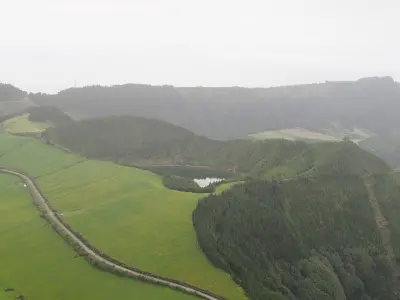
- Lagoa do Fogo, São Miguel: A protected natural reserve at 575 m altitude. The 2 km descent trail to the crater lake passes through well-preserved native forest.
- Sete Cidades, São Miguel: The 12 km circumnavigation trail around the twin lakes passes through ancient subtropical forest with over 150 endemic species recorded.
- Sete Fontes Forest Park, São Jorge: One of the best-preserved native forest patches in the archipelago, accessible and less visited than São Miguel options.
- Flores — island interior: The westernmost island of the Azores retains extensive humid forest patches with rare species.
Macaronesian Heath (Erica azorica): The Volcanic Pioneer
The Azorean heather (Erica azorica) is one of the most ecologically important endemic plants in the archipelago. This evergreen shrub or small tree of the family Ericaceae grows on all nine islands across an extraordinary altitudinal range: from sea level to the summit of Pico at 2,300 metres above sea level — the highest altitude recorded for this species anywhere. With an estimated population exceeding 100,000 individuals, it is among the most common endemic species in the Azores, and one of the most ecologically fundamental.
Erica azorica functions as a pioneer species, colonising disturbed terrain, fresh lava flows, and abandoned pastures, preparing the substrate for ecological succession and eventual native forest regeneration. At higher altitudes, exposed to Atlantic winds and persistent cloud, it forms characteristic heath communities in association with the Azores juniper and common heather (Calluna vulgaris). These "Azorean heathlands" — upland open shrublands of great landscape and ecological value — are among the archipelago's most distinctive vegetation types.
The plant produces tubular pink or lilac flowers, flowering primarily from October to March — making it one of very few species to bloom abundantly during the Azorean winter and providing a critical nectar source for pollinators in the colder months.
Where to See Azorean Heathland
Heath communities are visible on virtually every island above 600 metres. The most spectacular examples are found on the northern slopes of Pico (where heath colonises recent lava flows), on the high interior of Flores, and in the uplands of São Jorge. On São Miguel, the Caminho das Almas trail crosses well-established heathland. The EUNIS habitat classification recognises both upland Azorean heaths (Erica azorica and Juniperus brevifolia) and lowland Azorean heaths as distinct and protected habitat types within the European nature network.
Azores Juniper (Juniperus brevifolia): The Island Guardian
The Azores juniper (Juniperus brevifolia) is the only conifer endemic to the Azores and one of the rarest conifers in Europe. It grows on all nine islands at altitudes between 240 and 800 metres (rarely up to 1,500 metres), forming a shrub or small tree that may reach 6 metres in height with trunk diameters of up to 50 centimetres — dimensions that reflect centuries of slow growth on volcanic substrates. It is the sole Juniperus species occurring naturally in the Azores.
Phylogenetic research published in PLOS ONE (2011) suggests that J. brevifolia colonised the Azores archipelago multiple times from different ancestral populations — testimony to the complex history of plant colonisation of volcanic ocean islands. It was once a key component of native Azorean forests throughout the islands. Today it survives primarily in isolated patches on steep, inaccessible slopes in association with heath scrub, threatened by invasive species — particularly kahili ginger (Hedychium gardnerianum), Metrosideros (Metrosideros excelsa), and Japanese cedar (Cryptomeria japonica) — as well as historical pasture expansion.
The LIFE Priolo conservation project, coordinated by SPEA (the Portuguese Society for the Study of Birds), includes active removal of invasive species and replanting of J. brevifolia on the slopes of Pico da Vara on São Miguel, with documented positive outcomes for both the tree and the Azores bullfinch it shelters.
Where to See the Azores Juniper
The most accessible populations are in the high zones of São Miguel (Pico da Vara reserve), Flores (mountain interior), Pico (slopes above 600 m), and Corvo (caldera slopes). For a reliable close-up encounter, the Endemic Flora Garden at Parque Terra Nostra (Furnas, São Miguel) has labelled specimens of J. brevifolia alongside other Azorean endemics — an excellent orientation before field exploration.
Other Notable Azorean Endemic Species
The Azores' botanical richness extends well beyond the four species covered above:
- Azores orchid (Platanthera azorica): Considered the rarest orchid in Europe, found only on São Jorge and Faial in humid upland meadows. Flowers June–July.
- Azorina (Azorina vidalii): An endemic cliff-dwelling campanulaceous plant with white-to-blue tubular flowers. Iconic on Azorean sea cliffs.
- Hypericum foliosum: An Azorean endemic St John's wort with showy yellow flowers, common in humid valley habitats.
- Daboecia azorica: A low-growing endemic heath with vivid crimson flowers, characteristic of high-altitude heathland.
- Bellis azorica: An endemic daisy found in upland meadows and grasslands throughout the archipelago.
Conservation: Threats and Recovery Efforts
Approximately 98% of the original native forest of the Azores was cleared after colonisation in the 15th century, replaced by pasture, monoculture forestry, and invasive plant species that arrived intentionally or accidentally over five centuries of human habitation. Today, well-preserved laurissilva represents only a tiny fraction of total land area.
Conservation efforts include the Azores Protected Area Network (managed by the Regional Government), EU-funded LIFE projects, and volunteer programmes for invasive species removal coordinated by SPEA and the Azores Environment Study Group (GEA). The archipelago is fully covered by Natura 2000 Special Conservation Zones protecting the most sensitive habitats. The 2022 UNESCO Biosphere Reserve designation covering the entire Azores has given additional international visibility to these conservation efforts.
Visitors contribute most positively by staying on marked trails, not picking plants, reporting rare species sightings via iNaturalist, and choosing operators certified by the Azores' sustainable tourism programme. The informed attention of travellers is one of the most valuable assets the endemic flora of the Azores has.
When to Visit for the Best Flora Experience
- June–July: Hydrangeas at their most vivid. First upland orchids. Native forest at maximum lushness.
- August–September: Hydrangeas still in flower (turning progressively white as season ends). Heathland in good condition. Less cloud on high ground.
- October–March: Erica azorica in full winter bloom. Wildest landscape with fewest tourists. Higher rainfall and mist — waterproofs essential.
Frequently Asked Questions
Are hydrangeas native to the Azores?
No. Hydrangea macrophylla originates from Japan and China and was introduced to the Azores in the 19th century. It naturalised completely in the acidic volcanic soils of the archipelago and is now the islands' most iconic plant, despite being non-native. True endemic flora includes species like Laurus azorica, Juniperus brevifolia, and Erica azorica.
What is laurissilva and where can I see it in the Azores?
Laurissilva is an ancient evergreen broad-leaved forest that dates back 20 million years to the Tertiary period. It survives today only in the Macaronesian archipelagos. In the Azores, the best accessible examples are on the Pico da Vara trail and around Lagoa do Fogo on São Miguel, at the Sete Fontes Forest Park on São Jorge, and throughout the interior of Flores island.
Is the Azores juniper endangered?
Juniperus brevifolia is classified as vulnerable on the IUCN Red List. Its populations have been drastically reduced by habitat destruction and competition from invasive alien species. Active conservation programmes — including the EU-funded LIFE Priolo project — are working to restore populations on São Miguel and other islands.
How many endemic plant species does the Azores have?
The Azores has over 80 endemic vascular plant species out of approximately 1,000 total plant species recorded. Notable examples include Platanthera azorica (considered Europe's rarest orchid), Azorina vidalii, Daboecia azorica, and Hypericum foliosum.
Do I need a permit to hike through native forest areas?
Most protected nature reserve trails, including those around Lagoa do Fogo and Sete Cidades on São Miguel, are free-access with no prior booking needed. The Pico da Vara trail requires a free access permit, which can be obtained on-site in approximately 30 minutes. For the most ecologically sensitive areas and richest experience, hiring a local naturalist guide is strongly recommended.