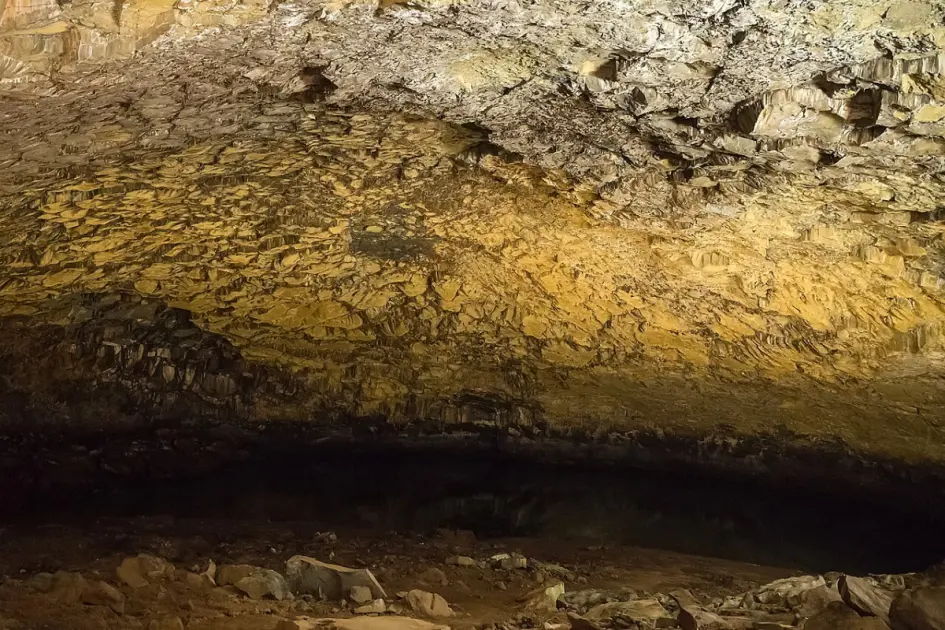
Graciosa Island is the Azores' best-kept secret: a UNESCO Biosphere Reserve measuring just 12.5 by 7 kilometres, where the biggest attraction on the island lies not on the surface but 22.5 metres below sea level — inside one of the world's most extraordinary volcanic caves. Known as the Furna do Enxofre, this lava cavern houses the largest volcanic dome in Europe, a sulphurous underground lake, and the kind of geological theatre that stops visitors in their tracks. Above ground, the island rewards the patient traveller with thermal baths operating since 1750, delimited wine-producing vineyards, 28 Flemish-style windmills, and a pace of life that feels entirely removed from mass tourism.
Furna do Enxofre: Europe's Largest Volcanic Dome
The Furna do Enxofre (Sulphur Cavern) sits at the base of the Graciosa Caldera, accessed via a 200-metre tunnel cut through the crater wall and a 37-metre stone tower fitted with a spiral staircase of 183 steps. The descent takes 10–15 minutes and requires a reasonable level of fitness, but the reward at the bottom is immediate and overwhelming: a perfectly domed cavern approximately 200 metres in diameter and 40 metres high at its centre, its ceiling formed by interlocking basalt prisms that assembled as lava cooled millions of years ago.
The cave floor holds a cold-water sulphurous lake, active degassing fields with carbon dioxide fumaroles, and yellow sulphur deposits that give the site its name. Atmospheric monitoring sensors installed throughout the cave continuously track gas concentrations, with automated alarms triggered if safe levels are exceeded — a reminder that Graciosa is geologically alive. The best time to visit is between 11 am and 2 pm, when direct sunlight penetrates through the dome's natural aperture and illuminates the interior with an almost otherworldly glow.
The cave was first scientifically explored in the 19th century when Prince Albert I of Monaco — an enthusiastic oceanographer and naturalist — descended to document its features alongside naturalists Fouqué and Hartung. Their accounts introduced Furna do Enxofre to the European scientific community. Today it is designated a Natural Monument of the Azores and receives visitors year-round through guided tours.
Visitor Information — Furna do Enxofre
- Summer hours (June–September): daily, 10:00–18:00
- Winter hours (October–May): Tuesday–Friday 10:00–17:00; Saturday 14:00–17:30 (closed Sunday and Monday)
- Guided tours: maximum 30 people; duration 40–60 minutes
- Adult ticket: €3.50 | Family (2 adults + children ≤ 17): €6 | Children ≤ 12: free | Youth / seniors: €1.75
- Best time to visit: 11:00–14:00 for the sunlight effect inside the dome
- Getting there: approximately 10 minutes by car from Santa Cruz da Graciosa; free parking at the Interpretation Centre
The Graciosa Caldera: Walking the Rim
The caldera that hosts the Furna do Enxofre is itself a remarkable landscape: 1.6 km across and 350 metres deep, one of the best-preserved volcanic collapse features in the Azores. A 3-kilometre circular trail follows the caldera rim, offering panoramic views across the entire island and, on clear days, to the neighbouring islands of Faial and Pico. The interior slopes are carpeted in Azorean laurisilva — ancient laurel forest, giant ferns, and native beech — and the silence inside the caldera is total. Allow approximately one hour at a relaxed pace.
Carapacho Thermal Baths: Hot Springs Since 1750
Perched at the island's southeastern tip against the dramatic cliffs of Ponta do Carapacho, the Termas do Carapacho are among the oldest operating thermal facilities in the Azores, continuously welcoming bathers since 1750. The mineralised water emerges naturally at approximately 40°C, drawn from aquifers fed by the geothermal heat beneath the Furna do Enxofre caldera. Historically used to treat rheumatic and skin conditions, the baths have been modernised to offer jacuzzis, Turkish baths, massage therapies, and contemporary spa treatments alongside the traditional thermal pools.
Just steps from the thermal establishment, natural lava pools provide free open-air swimming directly in the Atlantic Ocean, sheltered by volcanic rock formations. The contrast of soaking in a 40°C thermal pool then plunging into cool ocean water is an experience unique to Graciosa. The thermal waters are rich in sodium, magnesium, and carbonates — properties valued for their effects on arthritis, rheumatism, and inflammatory skin conditions.
Graciosa Wine: A Demarcated Region Since 1994
Viticulture on Graciosa dates to the 17th century, when Flemish and mainland Portuguese settlers introduced the first vines to the island's volcanic basalt soils. The Demarcated Region of Graciosa was formally established in 1994, recognising the distinct character of wines produced here. Graciosa's white wines — dominated by the Arinto dos Açores grape variety — are crisp, aromatic, and vibrantly acidic, ideal companions for the island's fresh fish and seafood. Small quantities of red wine are also produced using Merlot and Cabernet Sauvignon adapted to island conditions.
The Cooperativa Vitivinícola da Ilha Graciosa in Santa Cruz welcomes visitors for guided tastings and cellar tours (advance booking recommended). This is the best place to purchase bottles directly from the producer — wines from this small demarcated region are rarely found outside the archipelago, making them genuine Azorean souvenirs.
Santa Cruz da Graciosa: The White Town
The island capital, Santa Cruz da Graciosa, is a beautifully preserved historic town of white-rendered houses trimmed with dark volcanic basalt, centuries-old manor houses, and the 16th-century Igreja Matriz de Santa Cruz. The historic core has been classified as a Cultural Heritage site, and its unhurried streets are best explored on foot over a morning. The Graciosa Museum, housed in an 18th-century manor, presents ethnographic, archaeological, and natural history collections specific to the island.
The island's signature pastry — queijadas da Graciosa, delicate fresh-cheese tarts in thin pastry — can be found in the town's bakeries. The municipal market in Santa Cruz is the ideal place to stock up on local honey, fresh cheese, sugarcane aguardente, and island wines.
The Flemish Windmills
Among Graciosa's most distinctive visual landmarks are its 28 red-domed Flemish windmills, built between the 18th and 19th centuries by the island's Flemish-heritage settlers for grain milling. Several have been converted into characterful boutique accommodation — staying in one of these traditional mills, with panoramic views and contemporary interiors, is a quintessentially Graciosan experience. Moinho Boina do Vento, for example, offers stays from €85 per night.
Natural Pools and Swimming
Graciosa's natural pools are among the quietest in the archipelago. The Poceirões pools near the village of Praia are the local favourite: volcanic rock formations creating a sheltered, calm swimming area with easy access and no crowds. The Barro Vermelho pools on the north coast stand out for the vivid reddish hue of the ferrite-rich volcanic rocks contrasting with the deep blue Atlantic. At Carapacho, the natural pools adjoin the thermal baths, allowing bathers to combine both experiences.
UNESCO Biosphere Reserve: What It Means in Practice
Graciosa has held UNESCO Biosphere Reserve status since 2007 — a designation that reflects the island's exceptional balance between human habitation and ecosystem preservation. In practical terms, this means Graciosa has avoided the mass-tourism pressures that affect more prominent Azorean islands. Traditional agricultural practices are maintained, endemic fauna is actively protected, and the landscape remains largely unchanged from how it appeared a century ago. For the conscious traveller, Graciosa represents one of the purest expressions of sustainable tourism in the North Atlantic.
Getting to Graciosa
By air: SATA Air Açores operates regular flights from Ponta Delgada (São Miguel), Horta (Faial), and Terceira. Flight time is 30–45 minutes; fares from approximately €45 one way. By sea: Atlanticoline ferries run in summer (June–September), twice weekly from Faial and Terceira, with crossings of 3–5.5 hours.
On the island, car hire is essential — three local companies operate from the airport and offer rates from approximately €35 per day. The island's compact size (12.5 × 7 km) means it is entirely coverable in a single day, though three days is the recommended minimum to experience it properly.
Best Time to Visit
The optimal window is May through October. June to September brings the warmest temperatures (22–26°C), lowest rainfall, and best conditions for swimming and hiking. Outside peak season, Graciosa is almost entirely tourist-free — a genuine advantage for travellers seeking authenticity, though some restaurants and services operate reduced hours in winter.
Suggested 3-Day Itinerary
Day 1 — Caldera and Furna do Enxofre
Arrive and settle in Santa Cruz. Afternoon: walk the caldera rim trail (1 hour), then join the 3:00 pm guided tour of Furna do Enxofre. Dinner in Santa Cruz with freshly grilled fish and a glass of local Arinto white wine.
Day 2 — Thermal Baths, Natural Pools and Wine
Morning at the Carapacho thermal baths, followed by a swim in the adjacent natural pools. Afternoon: visit the Cooperativa Vitivinícola for a wine tasting and vineyard walk. Late afternoon: browse Santa Cruz market and try queijadas.
Day 3 — Windmills, Viewpoints and Poceirões
Circular drive around the island to photograph the red-domed windmills and take in the viewpoints at Ponta da Barca and Caldeirinha. Late morning swim at Poceirões natural pools. Free afternoon in Santa Cruz before departure.
Frequently Asked Questions About Graciosa Island
What is the Furna do Enxofre and why is it special?
The Furna do Enxofre is a volcanic lava cave located inside the Graciosa Caldera in the Azores. It is exceptional for containing the largest natural volcanic dome in Europe — approximately 200 metres in diameter and 40 metres high — formed by interlocking basalt prisms. Inside there is a cold sulphurous lake and active CO2 fumaroles. Guided visits cost €3.50 for adults and are available year-round.
Are the Carapacho thermal baths open year-round?
Yes, the Termas do Carapacho operate throughout the year, though opening hours may be reduced outside peak season. The thermal waters emerge at approximately 40°C and are recommended for rheumatic and skin conditions. The adjacent natural lava pools are free to access at any time.
Is Graciosa suitable for families with children?
Yes, with some caveats. The Furna do Enxofre staircase (183 steps) requires supervision for children and is not recommended for those under 8. The Poceirões and Carapacho natural pools are calm and safe for swimming. The island's quiet roads and compact size make logistics straightforward for families.
What wine should I try on Graciosa Island?
The Arinto dos Açores white wine is Graciosa's signature — fresh, aromatic, and crisp with citrus notes, perfectly paired with local fish. It can be tasted and purchased at the Cooperativa Vitivinícola da Ilha Graciosa in Santa Cruz. The Demarcated Region of Graciosa was established in 1994.
How do I get to Graciosa from Lisbon?
The fastest route is to fly from Lisbon to Ponta Delgada or Terceira, then take a SATA inter-island flight to Graciosa (30–45 minutes). Total travel time is typically 3–4 hours. In summer, a ferry connection also operates from Faial and Terceira via Atlanticoline.