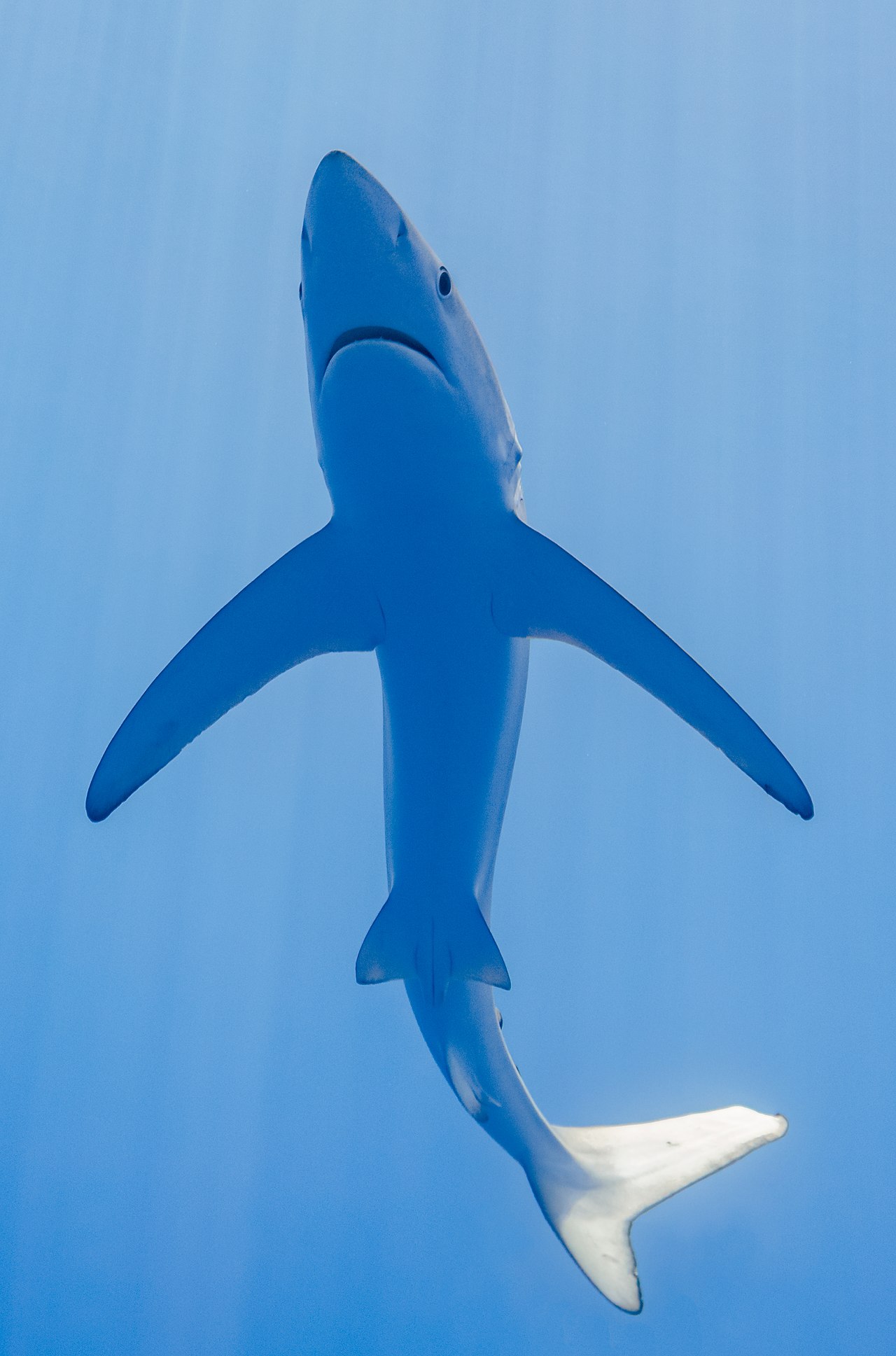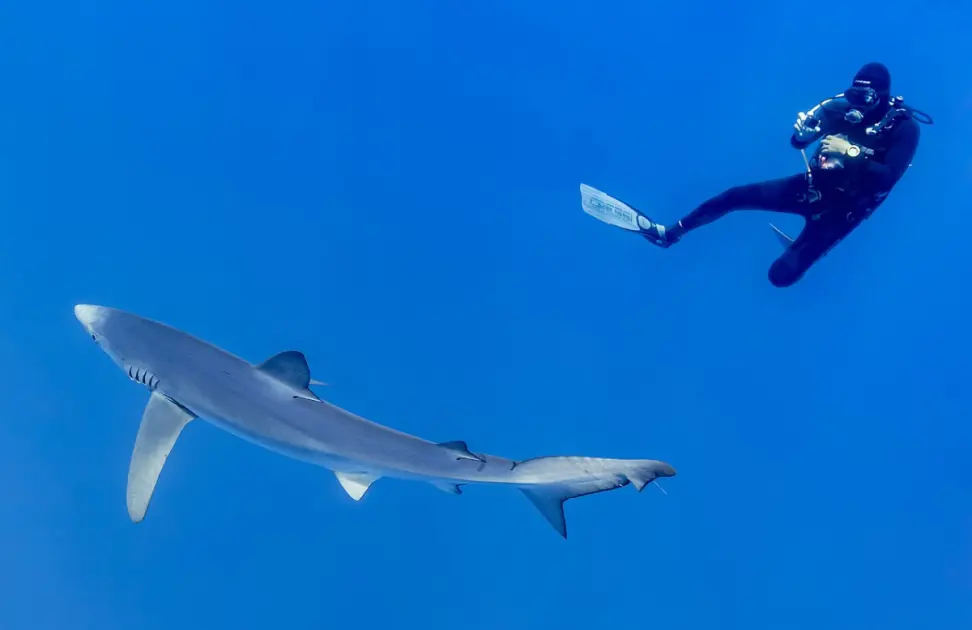
Scuba diving with sharks in the Azores ranks among the most extraordinary underwater experiences in Europe. Less than an hour by boat from Horta on Faial Island — or from Madalena on Pico — dozens of blue sharks and occasional mako sharks emerge from Atlantic depths to circle divers suspended in open water. There is no bottom in sight, only infinite blue and the silent grace of some of the ocean's most fascinating predators. This is pelagic diving in the Azores, a destination that Scuba Diving magazine consistently rates among the world's best for shark encounters.
Why the Azores Is a World-Class Shark Diving Destination
The Azores occupy a privileged geographic position in the North Atlantic, roughly 900 miles west of Lisbon. The chain of seamounts extending across the archipelago creates upwellings of cold, nutrient-rich water that attract plankton, baitfish and, in turn, large pelagic predators. Water clarity is extraordinary — visibility can exceed 40 metres at the height of the summer season.
Between June and October, blue sharks (Prionace glauca) migrate to these latitudes drawn by the abundance of prey. With a success rate exceeding 90% on organised expeditions, the Azores offer one of Europe's most reliable opportunities to encounter pelagic sharks in a wild environment.
Princess Alice Bank: The Azores' Most Legendary Seamount
Princess Alice Bank is a submerged mountain rising from the ocean floor to just 35 metres depth, located approximately 45 to 50 nautical miles southwest of Faial and Pico. The boat trip from Horta Marina takes around three hours — an open-ocean crossing that is itself part of the adventure.
The bank is one of the Atlantic's great wonders. From just 5 metres depth, divers encounter sweeping formations of devil rays (Mobula mobular), giant groupers, Atlantic tuna, and depending on season, Galapagos sharks (Carcharhinus galapagensis). Visibility can reach 40 metres and the current, while moderate to strong, constantly circulates marine life through the site.
Princess Alice is a technical dive requiring at minimum a PADI Advanced Open Water certification, excellent buoyancy control — there is no visual bottom reference — and experience with current diving. It is not suitable for beginners. Weather determines the viability of each departure and operators reserve the right to cancel on safety grounds.
Princess Alice Bank At a Glance
- Depth: 35 to 60 metres (shallowest point: 35 m)
- Visibility: 20 to 40 metres (best: July to September)
- Current: Moderate to strong
- Distance from Horta: ~50 nautical miles (3-hour boat ride)
- Typical species: Devil rays, Galapagos sharks, groupers, tuna, turtles
- Minimum certification: Advanced Open Water + pelagic experience recommended
Blue Shark Diving: The Open-Water Experience
The most sought-after shark diving experience for visitors to Faial and Pico is the pelagic blue shark dive. Unlike reef diving, this immersion takes place in open ocean, roughly 10 to 15 nautical miles from shore — about one hour by boat from Horta. Divers hang on lines in the water column with no bottom in sight, a sensation of space and vastness that no reef dive can replicate.
To attract the sharks, operators use chumming techniques — a mixture of fish offal placed at 5 metres depth, 20 metres behind the boat — without ever directly feeding the animals. Within 15 to 30 minutes, the first blue sharks ascend from depth.
The Blue Shark: A Curious Giant
The blue shark (Prionace glauca) is one of the ocean's most elegant predators. Averaging 2.2 metres in length with a maximum recorded at 4 metres, it is identified by its cobalt-blue dorsal colouring and white underside. It is classified as Near Threatened on the IUCN Red List, making every encounter an opportunity to support conservation awareness.
Blue shark behaviour at the Azores is consistently described by operators as curious and non-aggressive: the animals circle divers, approach to investigate and retreat. Their normal cruising speed is slow and contemplative, though they can reach 40 km/h when needed. Satellite tags placed on Azorean specimens have documented migrations of more than 11,000 km over 256 days — among the longest recorded for the species.
The Mako Shark: The Fast Visitor
The shortfin mako (Isurus oxyrinchus) is the world's fastest shark, capable of reaching 70 km/h. Averaging 3.2 metres in length, it is considerably larger than the blue shark. Its presence on expeditions is less frequent and encounters are brief — the mako tends to pass through, observe, and depart. It is classified as Vulnerable by the IUCN, with populations in decline across the North Atlantic.
When a mako arrives at a dive site, blue sharks typically retreat to the perimeter. It is a moment of extraordinary intensity, and operators instruct divers to remain still and not pursue the animal. The golden rule: never touch or feed sharks in the wild.
Best Season to Dive with Sharks in the Azores
The ideal window for shark diving in the Azores runs from June to October, peaking in July, August and September. During this period, water temperature ranges from 21 to 25°C, visibility is at its best and blue shark abundance is highest.
- June: Start of the season — first blue sharks arriving. Water still warming (18-20°C). Less competition for bookings.
- July and August: Peak season. Highest blue shark concentrations. Mako sightings more likely. Boat capacity fills fast — advance booking essential.
- September: Continuation of the high season. Warmest water (23-25°C). Excellent visibility. Ideal for underwater photography.
- October: End of the season. Blue sharks begin migrating south. More unpredictable weather but still good sighting probabilities.
Outside this window (November to May), shark expeditions are not operated — oceanic conditions and the absence of pelagic sharks in Azorean waters make departures unviable.
Certified Shark Diving Operators in the Azores
Choosing a certified and responsible operator is essential for diver safety and animal conservation. The best operators employ marine biologists, use responsible chumming practices and provide detailed briefings on shark behaviour.
Dive Azores — Horta, Faial
One of the principal shark diving operators based directly at Horta Marina. The company is run by Joana and Tiago, both marine biologists and dive instructors, operating since 2013. Shark expeditions head to Condor Bank, a seamount approximately 10 nautical miles southwest of Capelinhos Volcano — about one hour by boat. The company integrates an educational approach in all outings and is also a certified whale and dolphin watching eco-operator. Website: diveazores.net
CW Azores — Madalena, Pico
A leading operator based on Pico Island, just 30 minutes by boat from Horta. CW Azores runs shark expeditions and Princess Alice Bank trips. Reference pricing: €200 per single dive or €510 for a three-expedition package. Each diver receives a 12 or 15-litre tank with a maximum dive duration of 75 minutes. Requirements: Advanced Open Water, minimum 50 logged dives, minimum age 18, plus a check-dive with the operator beforehand. Website: cwazores.com
Norberto Diver — Faial
An experienced operator offering regular departures to Princess Alice Bank and pelagic shark dives from Faial. Well regarded for service quality and local knowledge of oceanographic conditions. Website: norbertodiver.pt
Requirements and Preparation for Shark Diving
Pelagic shark diving is a technical discipline not open to all divers. Azorean operators apply strict selection criteria to ensure the safety of everyone on board.
- Minimum certification: PADI Advanced Open Water (or SSI/CMAS equivalent)
- Minimum experience: 50 logged dives
- Minimum age: 18 years
- Buoyancy control: Essential — no bottom or surface reference during the dive
- Check-dive: Most operators require a prior assessment dive before the expedition
- Mental preparation: Diving in open water with no bottom visibility can be psychologically challenging for inexperienced divers
Recommended equipment: 5 mm semi-dry wetsuit (water can drop to 18°C in June), dive computer, gloves, hood and an underwater camera to capture the moment.
Conservation: Diving Responsibly
Blue sharks and mako sharks in the Azores are protected species under significant global conservation pressure. Overfishing — particularly for the fin trade — has reduced mako populations by more than 50% in recent decades. Azorean operators adopt responsible observation practices: no direct feeding, no physical contact, no pursuit of animals.
By choosing a certified operator following IUCN and PADI guidelines, divers contribute directly to the long-term sustainability of these experiences. Several Azorean operators participate in shark tagging and scientific research programmes, contributing vital data on migration and behaviour.
Other World-Class Dives Near Faial
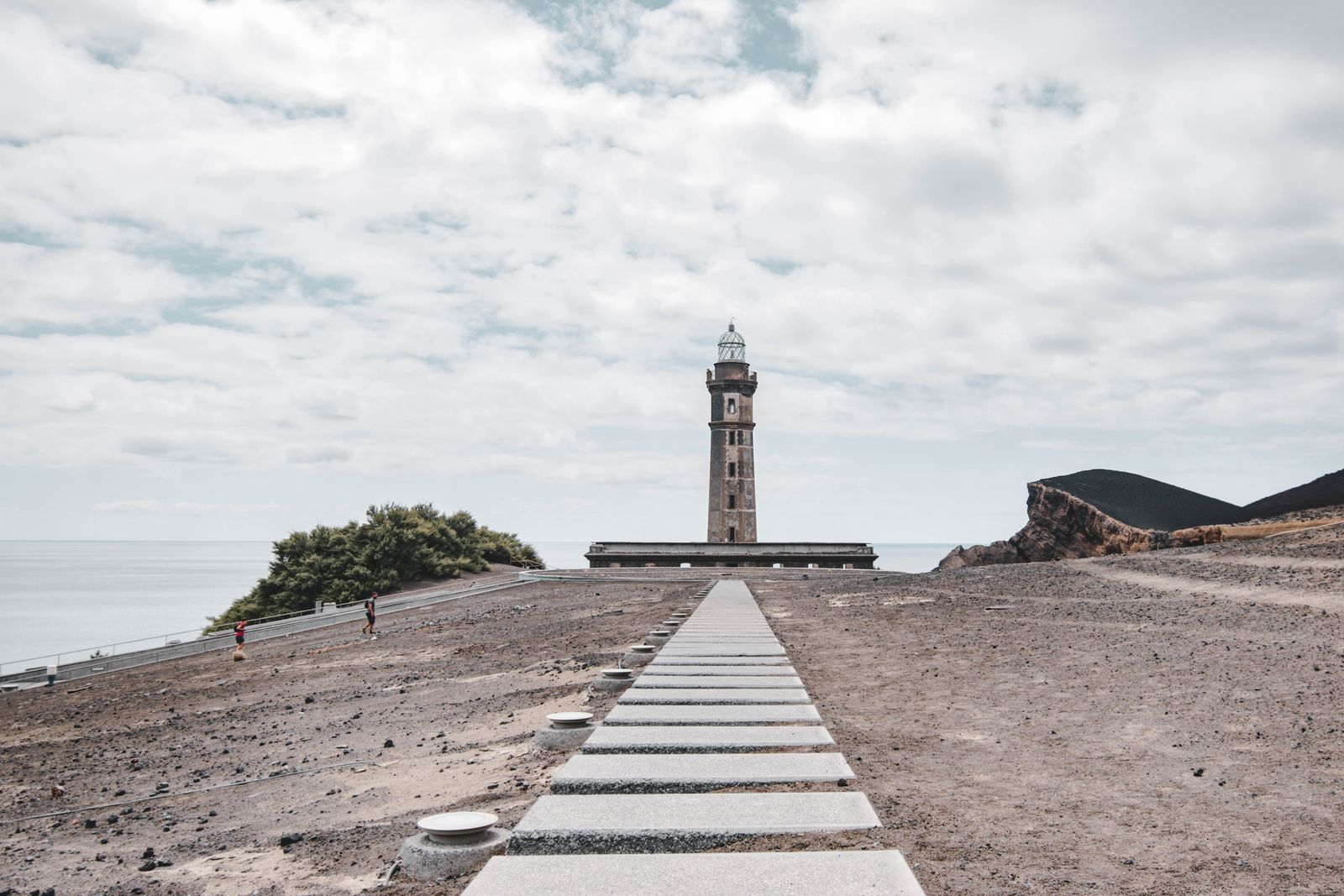
Faial offers much more beyond shark diving. The submarine lava fields of Capelinhos, created by the 1957–1958 volcanic eruption, provide a unique geological environment with black lava flows and rich benthic fauna. The island also serves as departure point for Condor Bank dives, where pelagic biodiversity includes Atlantic tuna, wahoo, mahi-mahi and occasional giant octopus.
Divers wishing to combine shark diving with other world-class immersions should plan a minimum 5 to 7-day stay in the Faial-Pico-São Jorge triangle — three islands less than 30 minutes apart by ferry, offering an unmatched concentration of top-tier diving in Europe.
Getting There and Where to Stay
Faial is served by direct flights with SATA/Azores Airlines from Lisbon, Porto and, during the summer season, from several European airports. Horta Airport is 10 minutes from the town centre. Horta Marina is one of the most famous in the North Atlantic — a mandatory stopover for transatlantic sailors — and provides a unique atmosphere that perfectly complements the diving experience.
Accommodation options include 3- and 4-star hotels, guesthouses and rural lodges across the island. Book 2 to 3 months in advance for peak diving season stays (July–August).
Frequently Asked Questions About Shark Diving in the Azores
Are the sharks in the Azores dangerous to divers?
Blue sharks are generally curious and non-aggressive toward divers. Incidents are extremely rare when operator guidelines are followed — no touching, feeding or pursuing animals. Mako sharks command greater respect given their size and speed, but certified operators manage these interactions with full safety protocols in place.
Do I need a special certification to dive with sharks?
Yes. Most operators require at minimum an Advanced Open Water certification (PADI, SSI or equivalent), a minimum of 50 logged dives and a minimum age of 18. A check-dive with the operator prior to the expedition is standard practice and strongly recommended.
What is the best time of year to dive with blue sharks in the Azores?
July to September is the absolute peak — the highest concentration of blue sharks, water temperature of 21–25°C and visibility up to 40 metres. June and October are valid alternatives with less competition for bookings.
How much does a shark diving expedition in the Azores cost?
Prices vary by operator. As a reference, CW Azores charges €200 for a single dive or €510 for a three-expedition package. Dive Azores (Faial) and other operators price expeditions in the €150–200 range, including equipment and briefing.
Is Princess Alice Bank suitable for beginner divers?
No. Princess Alice Bank is an advanced dive requiring experience with currents and pelagic diving. The minimum depth of 35 metres, distance from shore (3-hour boat ride) and moderate-to-strong current make it unsuitable for beginners. It is a dive for experienced divers seeking one of the Atlantic's most epic immersions.