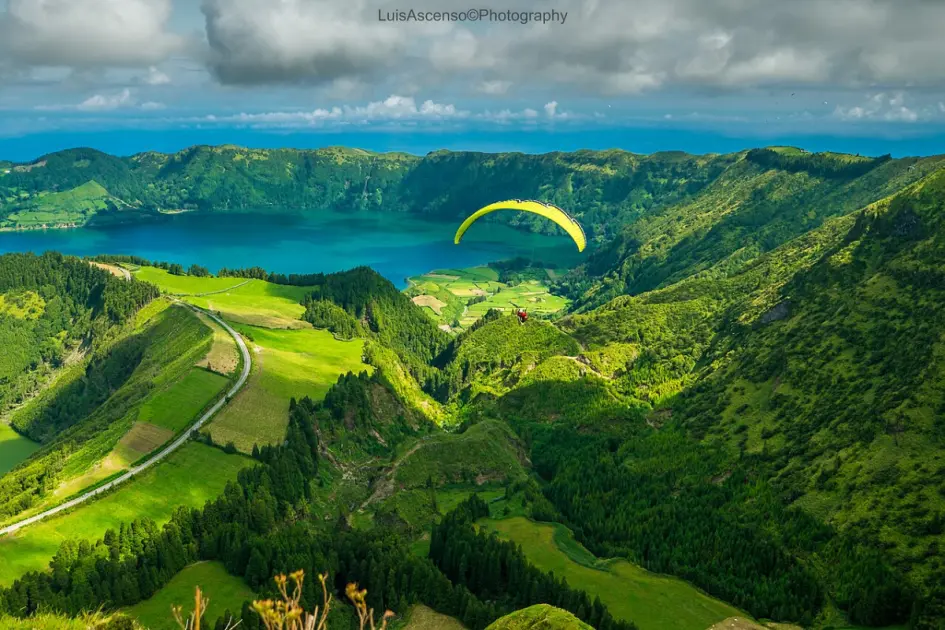
Paragliding in the Azores delivers a flying experience that few places on earth can match. Picture yourself soaring above a twin-lake volcanic crater, the deep Atlantic stretching to the horizon in every direction, hydrangea-covered slopes rolling beneath your feet. The Azores paragliding scene combines unique Atlantic meteorology, jaw-dropping landscapes, and a welcoming pilot community that draws free-flight enthusiasts from across Europe every single year.
São Miguel is the undisputed epicentre of free flight in the archipelago, but Pico, São Jorge, and Faial each offer extraordinary launch sites — ranging from coastal dunes at sea level to Portugal's highest summit at 2,351 m. This guide covers everything you need: the best launch sites by island, ideal seasons, certified operators, current prices, and practical tips whether you're booking a tandem flight or arriving with your own wing.
Why Paraglide in the Azores?
The Azores occupy a privileged position in the mid-Atlantic, roughly 1,500 km west of Lisbon. The Gulf Stream-moderated oceanic climate keeps temperatures mild year-round (14–25 °C) and creates a diversity of flying conditions rarely found in a single destination. The islands rise sharply from the sea — peaks above 900 m on São Miguel, up to 2,351 m on Pico — offering the full spectrum from coastal cliff soaring to technical cross-country (XC) flying over craters and laurel forest.
Sete Cidades on São Miguel was ranked among the 60 most beautiful free-flight sites in Europe by specialist magazine Cross Country Magazine. The island hosts the annual Azores Paragliding Festival, organised by Clube Asas de São Miguel (CASM) and now in its 22nd year — ranked in the Top 10 flying festivals in Europe. For one week each August, national and international pilots explore 15 official flying sites across the island.
Best Launch Sites by Island
São Miguel — The Heart of Azores Free Flight
São Miguel concentrates the greatest variety of launch sites in the archipelago, with take-off altitudes ranging from 400 to 950 m. Prevailing winds are from the northwest, but the island's complex topography ensures viable flying conditions in almost every wind direction.
- Sete Cidades — The flagship site. Launching from the rim of the ancient caldera allows soaring along steep grass slopes with postcard views over the twin lakes (one blue, one green). Late afternoons are ideal, as thermals moderate and the sea breeze builds.
- Lagoa do Fogo — One of the most technical sites on São Miguel, located at the island's centre near 950 m elevation. The dark volcanic lake creates interesting XC conditions on high-pressure days. Cloudbase regularly reaches 1,100–1,400 m on clear summer days.
- Furnas — Described by local pilots as "flying inside a volcano." The Furnas Valley offers soaring above steaming fumaroles and botanical gardens. The visual experience is genuinely unlike anywhere else in the paragliding world.
- Pico da Vara — The highest point on São Miguel (1,103 m), in the island's northeast. The area is wetter but when conditions align, XC routes linking Furnas, Lagoa do Fogo, and Sete Cidades are the prize for experienced pilots. The island XC distance record stands at approximately 52 km — and São Miguel is 65 km long.
- Maia / North Coast — Cliff soaring with open ocean views. The northern coastline has sufficient cliff height for extended soaring sessions on north-wind afternoons.
- Mosteiros — Low coastal launches ideal for student pilots or short introductory soaring flights.
- Faial da Terra – Ponta Garça — A classic XC coastal route along the southern shore, with landings on dark-sand beaches.
Airspace note: Restricted airspace exists south of Serra Gorda toward Ponta Delgada airport. CASM strongly advises contacting local pilots before flying and notifying ATC when XC flights are planned.
Pico Island — High-Altitude Flying
Pico is home to Portugal's highest mountain — Pico do Pico at 2,351 m — the highest peak in the entire European Atlantic. Launches range from 3 m coastal dunes to near 2,300 m on the volcano's flanks. High-altitude flying on Pico is terrain for certified pilots with solid mountain experience — conditions can change rapidly and the environment is technically demanding. The visual reward of soaring over UNESCO World Heritage vineyards while looking across to Faial and São Jorge is unmatched anywhere in the Azores.
São Jorge — Cliffs, Fajãs, and Drama
São Jorge stretches 53 km in length with cliffs exceeding 300 m — a dramatic soaring canvas. The island's famous fajãs (lava shelf platforms at the cliff base) create unique transition zones between ridge launches and sea-level landings. CASM pilots specifically recommend São Jorge as a must-visit complement to São Miguel for any serious flying trip to the archipelago.
Faial — Above the Caldeira
Faial's centrepiece is the Caldeira do Faial — 400 m deep, 2 km wide — a natural amphitheatre for free flight. Launches along the caldera rim (1,043 m elevation) produce impressive soaring with simultaneous views of Pico, São Jorge, and the open Atlantic. The capital Horta also offers accessible coastal soaring for less experienced pilots.
Best Seasons for Paragliding in the Azores
Paragliding is possible year-round in the Azores, but conditions vary considerably by season:
- May to October — The recommended window for most pilots. Weather is more stable, thermals are active (especially July–August), and cloudbase is higher.
- July and August — Peak season. July is statistically the driest month in the Azores; August coincides with the Paragliding Festival. Thermals regularly reach cloudbase and XC flights are most productive.
- September and October — Excellent for coastal soaring. Sea breezes are more consistent, tourist numbers are lower, and operators have greater availability.
- November to April — The rainier, windier season. Flyable days exist — particularly in March and April as spring depressions move through — but scheduling requires flexibility and patience.
Azorean weather famously offers "four seasons in a day." The IPMA (Portuguese Institute for Sea and Atmosphere) website at ipma.pt, combined with CASM's pilot weather group, are the essential daily planning tools for any pilot visiting the islands.
Certified Operators and Tandem Flights
For those without a pilot licence, tandem flights with a certified pilot are the best introduction to paragliding in the Azores. All legal operators must hold credentials from the FPVL (Portuguese Free Flight Federation) and comply with ANAC (National Civil Aviation Authority) regulations.
Azores Paragliding
Operated by Arnaldo Rocha — paragliding pilot since 1996, paramotor pilot since 2008 — this is one of São Miguel's most established operators. Services include tandem paragliding flights (15–30 min), paratrike (powered trike) flights, and local guide service covering access to private land and airspace management. Launch sites used span the entire island: Mosteiros, Sete Cidades, Lagoa do Fogo, Maia, Monte Escuro, Furnas, Povoação, Faial da Terra, and Nordeste. Bad-weather alternatives include 4×4 excursions and trekking. Contact: +351 913 078 656 / azoresparagliding@gmail.com.
Wind — Paragliding Centre São Miguel
Wind operates a delegation on São Miguel catering to both training pilots and experienced visiting flyers. The centre integrates with the main festival structure and maintains access to CASM's official sites network.
Clube Asas de São Miguel (CASM)
CASM is the central body of the free-flight community on São Miguel. It organises the Annual Paragliding Festival (August), maintains flying sites, and publishes site guides for visiting pilots. Website: asassaomiguel.com. Essential for independent pilots — local contact before any XC flight is strongly recommended.
Booking Platforms
Platforms including Manawa, Azores GPS, and TempoVip DMC Portugal broker tandem reservations with accredited local partners, making it straightforward for visitors without prior local connections to book safely online.
Prices for Paragliding in the Azores
Prices vary by flight type, duration, and operator:
- Tandem paragliding flight (15–30 min): approximately €150–€250 per person. Includes full equipment (harness, helmet, glider), safety briefing, certified pilot, and accident insurance.
- Paratrike / paramotor tandem flight: similar pricing to paragliding tandem; offers additional stability and access to low coastal flying zones.
- Pilot packages (7 nights): from €535 per person including accommodation, local transport, and guided site access (operators such as bstoked.net).
- Training courses: contact operators directly — FPVL regulates all licence courses in Portugal.
Most operators offer free cancellation up to 24–48 hours before the flight. Minimum age for tandem flights is generally 8 years; maximum weight 120 kg; minimum weight 50 kg. Tandem flights are not recommended for pregnant women or persons with serious cardiac conditions.
Hang Gliding in the Azores
Hang gliding has a significantly more limited presence in the Azores compared to paragliding. According to the local free-flight community, there are currently no active commercial hang gliding operators in the islands. However, visiting pilots arriving with their own equipment will find the launch sites accessible without major logistical barriers. The CASM is the recommended first contact for any hang glider pilot planning a visit — local knowledge on launch sites, landing zones, and airspace procedures is essential.
Practical Tips for Visiting Pilots
- Contact local pilots before you arrive. CASM and local operators understand the specific airspace nuances and microclimatic quirks of each site. A local briefing prevents wasted days and ensures safety margins.
- Bring wings for varied conditions. A soaring wing for coastal ridge days and a faster intermediate glider for thermal XC days suits the Azores' range of conditions well.
- Respect beach and landing-zone schedules. Some coastal landing zones have time restrictions to protect swimmers. Local operators manage access to private land and restricted areas.
- Build in flexibility. Azorean weather can shut down a flying window one day and deliver perfect conditions the next. Planning 7–10 days to secure 3–5 good flying days is the standard advice from experienced pilots who visit regularly.
- Check airspace and file NOTAMs. Always verify NOTAMs and notify Ponta Delgada ATC for XC flights — CASM guides pilots through this process.
- Ensure your travel insurance covers free-flight activities. Standard travel policies often exclude aerial sports; verify cover before departure.
Paragliding and Other Azores Adventures
Paragliding pairs naturally with the Azores' broader adventure offering. Many local operators combine flying days with canyoning and adventure sports, 4×4 excursions, and hiking. For water-based thrills, explore our guide to diving and snorkeling in the Azores or the complete guide to kayaking and stand-up paddle across the islands. Those who prefer land-based speed can combine a flying trip with mountain biking on the archipelago's best trails.
Frequently Asked Questions
Can I paraglide in the Azores with no prior experience?
Yes. Tandem flights with a certified pilot require zero prior experience. The passenger does not control the glider — the pilot manages everything. A safety briefing lasting approximately 10 minutes covers take-off and landing positions before the flight.
Which is the best Azores island for paragliding?
São Miguel is the best island for most visitors, thanks to its concentration of flying sites, active CASM community, and availability of commercial tandem operators. Experienced pilots seeking high-altitude challenges should also consider Pico (2,351 m) and São Jorge (300 m sea cliffs).
When is the Azores Paragliding Festival?
The Azores Paragliding Festival, organised by CASM, takes place annually in August — typically the second or third week of the month. It ranks among the Top 10 flying festivals in Europe and uses 15 official launch sites across São Miguel.
How much does a tandem paragliding flight cost in the Azores?
Tandem flight prices range from €150 to €250 per person, depending on operator, flight duration (15–30 minutes), and launch site. The price typically includes full equipment, safety briefing, certified pilot, and accident insurance.
Is hang gliding available in the Azores?
Commercial hang gliding operations are not currently established in the Azores. Visiting pilots with their own equipment can access launch sites, but should contact CASM for local guidance on sites, landing zones, and airspace procedures before flying.
Conclusion
Paragliding in the Azores is a bucket-list experience for any free-flight pilot — and an unforgettable first flight for first-timers taking to the air in tandem. The combination of volcanic scenery, mild Atlantic climate, and a passionate local pilot community creates a free-flight destination that stands apart from anything else in Europe. From the legendary craters of Sete Cidades to the altitude of Pico and the dramatic cliffs of São Jorge, every launch in the Azores opens a new perspective on one of the world's most beautiful archipelagos.
Book your tandem flight early in high season, connect with CASM if you're an independent pilot, and leave enough days in your itinerary to let the Azores weather show you its best side. The sky here has a colour all its own.