The Azores rank among Europe's most extraordinary destinations for stargazing. Positioned in the middle of the North Atlantic, more than 1,500 kilometres from the European continent, the archipelago benefits from minimal light pollution on its most remote islands, exceptionally clear Atlantic skies, and a latitude between 37° and 40° N that gives observers a wide celestial window covering most of the northern sky and a slice of the southern. More than 80% of the world's population can no longer see the Milky Way with the naked eye — in the Azores, on the right islands, it appears with a clarity that stops even experienced stargazers in their tracks.
This complete guide covers the best observation sites on every island, the Observatório Astronómico de Santana (OASA), the ideal Milky Way season, astrophotography tips, and everything you need to plan an unforgettable night under the Azores sky.
Why the Azores Are an Exceptional Dark Sky Destination
The geographic position of the Azores is difficult to replicate. The western group islands — Flores and Corvo — sit approximately 2,300 kilometres from Lisbon and over 3,700 kilometres from New York, making them among the least light-polluted inhabited lands in the entire North Atlantic. Even on the central and eastern islands, moving just a few kilometres from town centres reveals skies of outstanding quality. The Atlantic climate, while variable, produces some of the most transparent air in Europe when high pressure dominates — the same conditions that make the Azores attractive for daytime photography also create spectacular conditions for night-sky observation.
The archipelago's latitude allows observers to see northern constellations such as Ursa Major, Perseus, and Orion, but also southern stars like Canopus and Achernar that are virtually invisible from continental Europe. The Milky Way arcs across the sky for much of the year, and all five naked-eye planets are regularly visible.
Observatório Astronómico de Santana (OASA) — São Miguel
The Observatório Astronómico de Santana (OASA) is the Azores' principal centre for astronomical outreach and public observation. Located at Pico de Bode, in the parish of Rabo de Peixe, in the municipality of Ribeira Grande on São Miguel, the observatory was sited on an elevated, unobstructed position chosen specifically for its favourable observation conditions and extended views of the northern hemisphere sky.
OASA is part of the Azores Region Science Centre Network and is operated with science education and outreach as its primary mission, focusing on astronomy and space exploration. Its facilities include advanced telescopes for public observation sessions, a planetarium, permanent exhibitions on the solar system and universe, and educational programmes for school groups and families.
Guided night observation sessions are led by specialist astronomers who identify constellations, visible planets, and deep-sky objects including nebulae and star clusters. For visitors with no prior astronomy experience, it is the most accessible entry point — professional-quality equipment combined with expert guidance transforms an abstract night sky into a legible, extraordinary story. OASA welcomes individual visitors, school groups, and tourists, and advance booking is strongly recommended, especially in summer months.
Practical Information — OASA
- Location: Pico de Bode, Rabo de Peixe, Ribeira Grande — São Miguel
- Contact: spaceazores.pt / (+351) 296 248 410
- Sessions: Scheduled night sessions — check the website for current dates and availability
- Audiences: Families, school groups, and individual tourists
- Highlights: Advanced telescopes, planetarium, educational programmes
Milky Way Season in the Azores
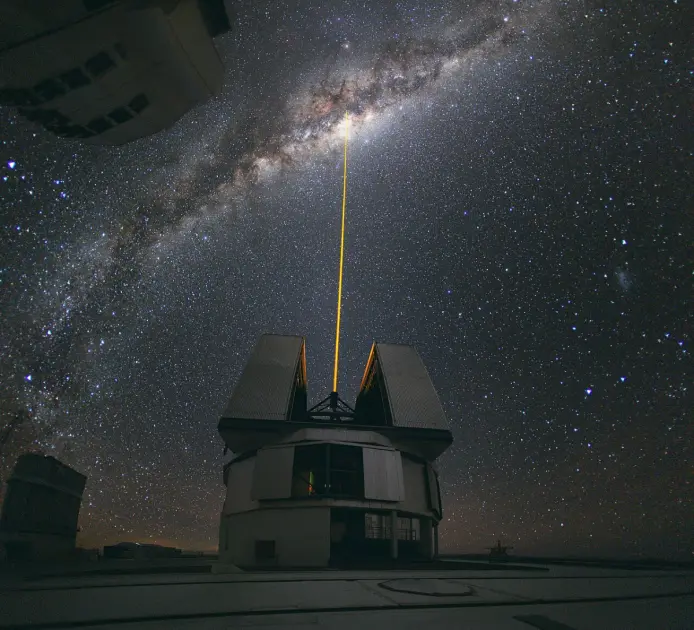
The Milky Way is visible from the Azores between March and November. The galactic core — the dense, luminous band at the heart of our galaxy and the most visually spectacular part of the Milky Way — rises above the southern horizon from April through September. The absolute peak for galactic core visibility falls between June and August, when it reaches its highest point in the sky around local midnight.
For optimal viewing, plan observation nights around the New Moon phase — moonlight is the single greatest obstacle to Milky Way visibility, even on islands with zero artificial light. Apps such as Stellarium, PhotoPills, or Milky Way Atlas allow you to preview exactly where the galactic core will be on any given night at any location in the archipelago.
Sky quality is measured by the Bortle scale, which runs from 1 (the darkest skies on Earth) to 9 (inner-city skies). On Flores and Corvo, the most remote sites achieve Bortle 2–3, comparable to the world's leading observatory sites. On São Miguel, outside population centres, Bortle 4–5 conditions are achievable. These are exceptional numbers for a European destination.
Best Stargazing Spots by Island
São Miguel — Lagoa do Fogo and Pico da Vara
On São Miguel, the archipelago's most populous island, the best observation locations are at higher elevations well away from Ponta Delgada's urban glow. The Miradouro da Lagoa do Fogo viewpoint, at around 500 metres elevation, offers a broad southern sky view ideal for tracking the Milky Way core in summer. The Pico da Vara (1,103 m), the island's highest point, rewards more adventurous observers prepared to hike up at dusk with outstanding 360° views above much of the atmospheric haze. The best viewpoints in the Azores article covers access details for Lagoa do Fogo and other elevated spots.
Pico Island — The Top of Portugal
Pico Island is home to Mount Pico, at 2,351 metres the highest peak in Portugal and one of the finest stargazing locations in the entire Atlantic. At altitude, the atmospheric humidity that affects sea-level observation largely disappears, and the island's oceanic isolation means artificial light is virtually absent above 1,500 metres. Ascending Pico for a night of observation — the hike takes 3–4 hours each way and requires advance permits from the Azores Mountain Natural Park — is an experience that dedicated astronomers describe as life-changing. The Portuguese astrophotographer Miguel Claro, whose work has appeared in NASA's Astronomy Picture of the Day, has captured iconic images of the Milky Way rising over Mount Pico.
For those not wishing to summit, the UNESCO World Heritage lava fields surrounding the volcano's base — particularly the Criações Velhas vineyard landscape — offer open horizons and excellent dark sky conditions at manageable elevations. The Pico UNESCO vineyards guide provides essential context about this extraordinary landscape.
Flores Island — Portugal's Future Dark Sky Sanctuary
Flores is arguably the most exciting dark sky destination in the Azores for the coming years. There is an active initiative to designate Flores as the first IDA (International Dark-Sky Association) Dark Sky Sanctuary in Portugal — a classification reserved for remote lands with exceptional sky quality, specifically protected for scientific, natural, or educational value. The IDA Sanctuary designation is among the most prestigious in the field of dark sky preservation and is supported by UNESCO and the International Astronomical Union.
Flores' existing status as a UNESCO World Biosphere Reserve reinforces this trajectory. The island's western coastal viewpoints at elevations above 700 metres offer unobstructed Atlantic horizons in all directions, ideal for observing the Milky Way rising and setting. The absence of significant urban centres keeps the sky background extraordinarily dark. Flores is also featured in our guide to Flores and Corvo, including practical access information for the island's most remote viewing points.
Corvo — The Darkest Island in the Azores
Corvo, with fewer than 450 permanent inhabitants, is the smallest and most isolated island in the Azores, and almost certainly offers the darkest skies in the archipelago. The Caldeirão do Corvo — the vast volcanic caldera at the island's centre — is a remarkable observation site. Standing on its rim, you have the Atlantic Ocean at 360° and a horizon entirely free of artificial light. The near-complete absence of tourism infrastructure and the island's extreme remoteness preserve Corvo in a state of nocturnal darkness that has become genuinely rare in Europe.
Graciosa — Quiet Observation in the Central Group
Graciosa is an understated island whose open agricultural landscape and gently rolling hills provide above-average observation conditions for the central group. The interior elevated areas and farmland away from Santa Cruz da Graciosa offer quiet, undisturbed nights with the distinctive silhouettes of Pico and Faial providing a minimal light frame on the horizon. Graciosa rewards the traveller who seeks contemplative, solitary stargazing over organised activities.
São Jorge — Fajas and Open Skies
São Jorge is a long, narrow island with a high central ridge that creates distinct microclimates on each flank. Its celebrated fajãs — lava shelf platforms at sea level — offer observation from near-isolated positions with total Atlantic horizons. The Fajã dos Cubres and Fajã de Santo Cristo, accessible only on foot or by rough track, are recommended by astrophotographers familiar with the archipelago as exceptional sites for full-sky observation. The complete São Jorge fajas guide covers access routes and seasonal conditions.
Faial — Caldeira do Faial and the Northern Coast
On Faial, the Caldeira do Faial at 1,043 metres elevation delivers high-altitude viewing with broad horizons and reduced atmospheric interference. The island's northern coast, sparsely populated, is another strong option. The visual relationship between Faial and Pico — just 6 kilometres apart — creates one of the most dramatic night-sky compositions in the archipelago: the dark silhouette of Mount Pico rising against the Milky Way, viewed from the Faial shoreline.
Terceira — Ponta do Queimado
On Terceira, Ponta do Queimado on the island's eastern tip is the established reference point for stargazing. The rugged coastline and the absence of artificial light on this extremity of the island create workable conditions, though Terceira is the most urbanised of the central group islands. The complete Terceira guide provides orientation for reaching the eastern tip from Angra do Heroísmo.
Santa Maria — Clear Skies of the Southern Azores
Santa Maria is statistically the sunniest island in the Azores and has more clear nights per year than any other island in the archipelago. Its mountainous interior, particularly around Pico Alto, offers good observation conditions with an above-average probability of cloud-free nights — a significant practical advantage when planning a stargazing trip.
Astrophotography Tips for the Azores
- Camera: Full-frame or crop sensor with strong high-ISO performance. ISO 3200–6400 is typical for Milky Way shots.
- Lens: Wide-angle (14–24 mm), maximum aperture f/2.8 or wider. A fast f/1.8 or f/2 prime lens is ideal.
- Shutter speed: Use the 500 Rule — divide 500 by your focal length to find the maximum exposure in seconds before star trails appear. At 20 mm: 25 seconds maximum.
- Focus: Manual focus on a bright star using maximum Live View magnification. Auto-focus does not work in darkness.
- Composition: Incorporate Azorean landscape elements — a volcanic crater rim, the Pico vineyard walls, a coastal lava platform — to give the image human scale and regional identity.
- Apps: PhotoPills (Milky Way planning and AR visualisation), Clear Outside (layer-by-layer cloud forecasting), Stellarium (real-time sky map), Light Pollution Map (Bortle scale by location).
- Clothing: Even in summer, temperatures at elevation drop to 10–14°C after midnight. Bring warm layers regardless of daytime conditions.
Practical Tips for Your Stargazing Night
Allow your eyes 20–40 minutes to fully dark-adapt after arriving at your observation site. Avoid any white light source during this period — even a brief glance at an unfiltered smartphone screen resets dark adaptation in seconds. Use a headlamp with a red light mode, which preserves night vision.
Check weather forecasts specific to the altitude and location you plan to visit. Azorean weather is famously changeable — a clear evening can transition to coastal cloud or mountain mist within an hour. The apps Windy and Clear Outside are particularly reliable for Atlantic island conditions.
Several local operators on São Miguel, Pico, and Faial offer guided night observation excursions that include transport, a specialist guide, and in some cases access to the OASA telescopes. These tours are the most practical and safe option for first-time visitors, and the guides' knowledge of local sky conditions and optimal sites is invaluable.
Frequently Asked Questions About Stargazing in the Azores
What is the best time of year to see the Milky Way in the Azores?
The Milky Way is visible from the Azores from March through November. The galactic core — the brightest, most visually dramatic section — is highest in the sky between June and August, making summer the prime season. Schedule your observation for nights around the New Moon to eliminate lunar interference.
Which Azores island has the darkest skies?
Corvo is generally considered the darkest island in the archipelago due to its extreme isolation and minimal urbanisation. Flores and São Jorge are close behind. On São Miguel — the easiest island for most visitors to reach — good dark sky conditions are achievable at higher elevations well away from Ponta Delgada.
Is the Observatório Astronómico de Santana open to the public?
Yes. OASA (Observatório Astronómico de Santana), located in Rabo de Peixe, Ribeira Grande, São Miguel, is open to the public and runs guided night observation sessions with advanced telescopes. Advance booking is strongly recommended, especially from June to September. Visit spaceazores.pt for current session schedules.
Can you see the Milky Way with the naked eye in the Azores?
Yes. On the darker islands — Corvo, Flores, and São Jorge — the Milky Way is clearly visible to the naked eye on New Moon nights from April through September. Even on São Miguel, away from urban light, the galactic band is discernible under favourable conditions.
Do I need a telescope to stargaze in the Azores?
No. Under dark Azores skies, the naked eye reveals thousands of stars, the Milky Way, constellations, bright planets, and even the Andromeda Galaxy (M31) — the most distant object visible without optical aid, 2.5 million light-years away. A basic pair of 7×50 or 10×50 binoculars dramatically expands what is visible. A 4–8 inch telescope unlocks planetary detail, nebulae, and star clusters in breathtaking resolution.